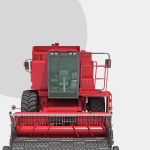





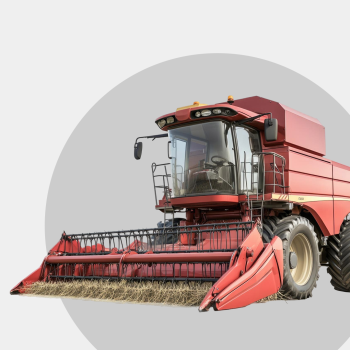
- For more than 11 years, farmers were unable to purchase Claas agricultural machinery and spare parts at competitive prices or from a dealer of their own choosing.
- This resulted from a restrictive agreement.
- The President of UOKiK, Tomasz Chróstny, has issued a decision imposing penalties totalling more than PLN 170 million on six companies.
Mr Marek is a farmer. He has been using Claas tractors for many years. He is familiar with these machines and satisfied with them. Therefore, when he wanted to buy a new tractor a few years ago, he searched for the same brand. He wanted to compare offers to choose the most advantageous one. Unfortunately, when he called dealers, he was always directed to the one closest to his farm. When he asked to be shown an offer from another dealer, the price always turned out to be higher. As a result, wanting to remain with the brand, Mr Marek had no choice — he had to use the offer of the dealer nearest to his location and buy the machine at the price they proposed.
Long-standing collusion
Mr Marek is a fictional character. However, the mechanism applied by Claas farm machinery dealers is real. It was the result of long-standing collusion to restrict competition by dividing customers territorially, which was reinforced by resale price fixing. The illegal agreement was concluded by Claas Polska, which manages the distribution system for Claas agricultural machinery, and five dealers of the brand: Agro Sznajder WKP, Przedsiębiorstwo Techniczno-Handlowe Roltex, Świerkot, Agrimasz, and Agroas. The collusion lasted more than 11 years – at least from October 2011 to January 2023. The President of UOKiK imposed penalties totalling more than PLN 170 million on the undertakings.
– Many farmers buy agricultural machinery of the same brand over the years. This is due to familiarity with the equipment, access to spare parts, and the ability to service and repair it, as well as concerns about switching brands. That is why the collusion concerning the sale of Claas machinery and spare parts was extremely detrimental to farmers. In exchange for their brand loyalty, they were offered a higher price than they could have obtained under fair competition among dealers – says Tomasz Chróstny, the President of UOKiK.
Market sharing
We politely informed him that he was far from our service area and that we would have to sell to him at a much higher price due to the distance, and that it was best to buy from the dealer closest to him. The rest is up to you.
This is the content of one of the e-mails obtained by UOKiK during a search at the companies’ offices. In a nutshell, the message shows how the unlawful agreement operated. Dealers were assigned areas in which they could sell machines. The unlawful arrangements involved restricting passive sales to customers outside the assigned territory — that is, when a farmer approached the dealer independently to request an offer. In such cases, he was asked where he lived or farmed. If this was outside the dealer’s assigned area, the potential buyer was directed to the “territorially appropriate” dealer. Dealers informed each other about such contacts, including through Claas Polska. Market sharing was reinforced by pricing arrangements. Their aim was to present a less favourable offer if a farmer from outside the dealer’s assigned area expressed interest in purchasing a machine.
The evidence collected indicates that Claas Polska played an active role in maintaining both the divisional and pricing arrangements within the distribution network. It acted as the coordinator and gatekeeper of these arrangements and monitored the market behaviour of dealers. It also participated in correspondence regarding the transfer of enquiries between dealers when customers came from outside their assigned territories.
The dealers themselves also monitored each other’s conduct and complained to Claas Polska if any of them failed to comply with the collusive arrangements. On the other hand, if a dealer sold a machine to a farmer outside “their” area, they paid financial compensation to the dealer whose area had been infringed.
Fines
Fines imposed on individual companies totalled more than PLN 170 million (PLN 170,382,000.00):
- Claas Polska — PLN 71,246,000.00
- Agroas — PLN 48,665,000.00
- Agro Sznajder WKP — PLN 15,402,000.00
- Agrimasz — PLN 13,202,000.00
- Świerkot — PLN 12,498,000.00
- Przedsiębiorstwo Techniczno-Handlowe Roltex — PLN 9,369,000.00
The decision is not final; the companies have the right to appeal to the court.
– The decision issued is another step in defending the economic interests of farmers. We intervene both in cases of abuse of superior bargaining power by major market players and in cases of infringements of competition rules. Among other things, two further proceedings concerning the sale of agricultural machinery are pending – says Tomasz Chróstny, the President of UOKiK.
You can seek redress
Anyone who has suffered a loss as a result of a breach of competition law may file a civil lawsuit against any of the entities that have broken the law. Claims for compensation may be pursued under the Act on Private Enforcement, which came into force in 2017. The President of UOKiK has prepared and published a special study in which he provides a closer look at the regulations on these issues.
The leniency programme
The maximum fines for participation in an anti-competitive agreement is 10 per cent of turnover for business entity and PLN 2 million for managers. Severe penalties for participation in collusion can be avoided through the leniency scheme. It offers businesses involved in an illegal agreement and managers responsible for entering into a collusion arrangement an opportunity to reduce a sanction or, in some cases, avoid it altogether. It is intended for those who agree to cooperate with the President of UOKiK as a “crown witness” and provide evidence or information regarding the existence of a prohibited agreement. We encourage the parties interested in the leniency scheme to contact UOKiK at a dedicated phone number: 22 55 60 555. UOKiK staff will answer any questions about the leniency programme, including anonymous ones.
A platform for whistleblowers
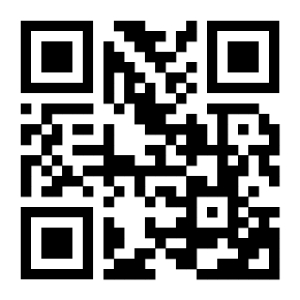
We also remind you that we have a platform for obtaining information from anonymous whistleblowers. Do you wish to inform UOKiK about competition-restricting practices? Visit https://uokik.whiblo.pl/ or scan the QR code below and use the simple form. The system we use guarantees full anonymity, including from UOKiK.
Files to download
Information for the media
 | +48 603 124 154 |
 | biuroprasowe@uokik.gov.pl |
 | Pl. Powstańców Warszawy 1 00-950 Warszawa |
Follow us
   @UOKiKgovPL @UOKiKgovPL |
See also