





- There is a constant battle for our attention online, and purchasing decisions are increasingly made in a matter of seconds.
- That is why this year's World Consumer Day is dedicated to dark patterns – tricks used on websites and in applications that make it difficult to make informed choices.
- On this occasion, we present a guide showing how to recognise digital traps.
Online shopping is fast and convenient. That is why it is easy to overlook the moment when this convenience begins to work against us. Sometimes all it takes is a highlighted button, a default option, or a message suggesting the ‘best’ choice. Suddenly, it turns out that in the digital world our decisions are no longer determined solely by what we need, but also by how information is presented to us. World Consumer Day, which will be celebrated on 15 March, is a good opportunity to take a closer look at this.
– On World Consumer Day, I wish that every click we make is based on a calm and conscious decision. Today, the battle is not only for our money, but also for our attention, time, and personal data. Some websites and applications are designed to speed up decisions, make it difficult to refuse and distract us from important information. Let us pause for a moment, look carefully at the screen, and ask ourselves a simple question: am I really choosing for myself? The greater our awareness, the more difficult it becomes to manipulate us – says Tomasz Chróstny, the President of UOKiK.
Take a look at our guide
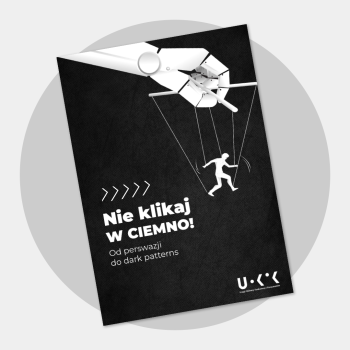
UOKiK has prepared a guide entitled ‘Don’t Click Blindly! From persuasion to dark patterns’. It is a practical guide for online consumers, helping them to recognise the most common techniques used to influence them online and regain control over their own decisions.
In the guide, we show situations in which it is easiest to let your guard down. These include additional services and products ‘added’ to your basket, surcharges that only appear at the end of the purchase process, subscriptions that are easy to activate but difficult to cancel, and screens that create pressure by displaying a timer or artificially creating the impression that a product is so popular that it may soon be out of stock.
We also advise on how to respond to deceptive interfaces. It is always worth checking the full costs before payment, carefully reading what has been pre-selected, comparing offers and not making decisions simply because we are being urged to do so. Sometimes it is enough to pause for a moment to avoid unnecessary expenditure or unwanted consent.
You can find more examples and practical tips in our guide. We encourage you to download it and use it when making your everyday online shopping decisions.
Information for the media
 | +48 603 124 154 |
 | biuroprasowe@uokik.gov.pl |
 | Pl. Powstańców Warszawy 1 00-950 Warszawa |
Follow us
   @UOKiKgovPL @UOKiKgovPL |
Help for consumers
| 801 440 220 | +48 222 66 76 76 operator fee |
 | dlakonsumentow.pl contact form |
| Consumer Ombudsmen in your town or district |
| Trade Inspection in your province |
See also