



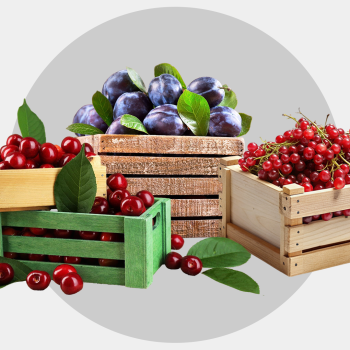
- Farmers and fruit growers in Greater Poland were forced to sell their fruit at below-market prices for over two years.
- This was the result of price-fixing by fruit purchasing centres.
- The President of UOKiK imposed fines totalling over PLN 1.5 million on five businesses and one individual.
The same low purchase prices for fruit, such as cherries and currants, were observed across the entire region. It was not profitable to transport fruit to more distant locations where prices were higher. This was the situation faced by farmers in the Konin district and the surrounding area. The cause was price-fixing by fruit buyers operating in the region: Fructis of Wierzbie (Wielkopolskie), Damex of Nowa Wieś (Wielkopolskie), Silver-Trans of Sompolno (Wielkopolskie), Kam-Pol of Biała Rawska (Łódzkie), and Kalbrok of Sielice (Mazowieckie). The unlawful agreement lasted for three fruit harvesting seasons between 2022 and 2024. Throughout each purchasing season, the operators regularly exchanged information via messaging apps regarding fruit purchase prices and set prices at their respective collection points.
– The aim of the collusion was to set fruit purchase prices as low as possible. This meant that farmers from Greater Poland received reduced rates for their hard work over three harvest seasons – says the President of UOKiK, Tomasz Chróstny.
Evidence from instant messaging platforms
One piece of evidence of unlawful agreement was information obtained from the business owners’ instant messaging platforms during a search of Fructis’s premises. This material confirms that information regarding fruit prices was exchanged and demonstrates that the aim of the collusion was to avoid price competition between the owners of fruit purchasing centres. Below are examples of messages (translated from Polish):
We’ve got to come up with something. It’s crazy to be competing like this (…) Let me know what we’re doing. I can compete on price, but it’s not healthy for any of us.
– Hey, what are the prices for cherries and currants today? – Cherries 2.30, currants 2.20, net prices
Fines
The President of UOKiK issued a decision imposing financial sanctions totalling PLN 1.57 million for participation in an agreement restricting competition. Among those penalised is the CEO of Fructis, who was directly responsible for the operation of the collusion.
Amounts of individual fines:
- Damex – PLN 452,000
- Kam-Pol – PLN 391,000
- Fructis – PLN 299,000
- Kalbrok – PLN 265,000
- Silver-Trans – PLN 59,000
- Andrzej Sarnowski – PLN 110,000
The decision of the President of UOKiK is not final and may be appealed to the court.
UOKiK for farmers
– Protecting Polish farmers is one of our priorities. This is yet another intervention aimed at improving their situation. We will also continue to monitor the market during this year’s harvest season – says Tomasz Chróstny, President of UOKiK.
Investigations are currently underway following inspections at three major processors: Austria Juice Poland, Döhler, and Rauch Polska, as well as at three entities with purchasing centres: Przetwórstwo Owoców i Warzyw Anna Wagnerowska, Makofrost (both from Opole Lubelskie), and Frutica of Lewiczyn. We are verifying whether price fixing may have occurred at any level of trade under examination. The proceedings are conducted in rem, not against any specific entrepreneurs.
Price-fixing versus parallel pricing
It is worth highlighting the difference between prohibited price-fixing and legally permitted parallel pricing. The former involves agreements to fix prices, that is, joint and coordinated actions by independent businesses. The latter, however, involves observing competitors’ prices and adjusting one’s own prices accordingly. This is a very significant distinction – a low or even identical price in several places does not automatically mean that there is a price-fixing agreement, i.e. an illegal practice.
You can seek redress
Anyone who has suffered a loss as a result of a breach of competition law may file a civil lawsuit against any of the entities that have broken the law. Claims for compensation may be pursued under the Act on Private Enforcement, which came into force in 2017. The President of UOKiK has prepared and published a study in which he provides a closer look at the regulations on these issues.
The leniency programme
The maximum fines for participation in an anti-competitive agreement is 10 per cent of turnover for business entity and PLN 2 million for managers. Severe penalties for participation in collusion can be avoided through the leniency scheme. It offers businesses involved in an illegal agreement and managers responsible for collusion an opportunity to reduce a sanction or, in some cases, avoid it altogether. It is intended for those who agree to cooperate with the President of UOKiK as a “crown witness” and provide evidence or information regarding the existence of a prohibited agreement. We encourage those interested in the leniency scheme to contact UOKiK at a dedicated phone number: 22 55 60 555. UOKiK staff will answer any questions about the leniency programme, including anonymous ones.
A platform for whistleblowers
We also remind you that we have a platform for obtaining information from anonymous whistleblowers. Do you wish to inform UOKiK about competition-restricting practices? Visit https://uokik.whiblo.pl/ and fill out a simple form. The system we use guarantees full anonymity, including from UOKiK.
Files to download
Information for the media
 | +48 603 124 154 |
 | biuroprasowe@uokik.gov.pl |
 | Pl. Powstańców Warszawy 1 00-950 Warszawa |
Follow us
   @UOKiKgovPL @UOKiKgovPL |

See also