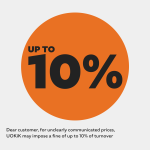


- Bargain – buy at a higher price. Price reduction – take our word for it. Discounts – calculated to look big.
- Buyers on the Zalando and Temu platforms were not properly informed about promotions, including the lowest price in the 30 days before the discount.
- The President of UOKiK issued two decisions imposing fines on Zalando and Temu, totalling nearly PLN 37 million.
The lowest price in the 30 days before the discount is a mandatory element of information about the reduction and serves as a reference point for calculating the discount amount. This requirement was introduced with the implementation of the Omnibus Directive in 2023. Since then, the President of UOKiK has been monitoring the market and addressing irregularities in this area. The latest decisions concern the popular sales platforms Zalando and Temu. The total fines for violating the collective interests of consumers amount to nearly PLN 37 million.
– Businesses are responsible for properly informing consumers about discounts and promotions. Presenting price increases as bargains and selectively or manipulatively displaying discounted prices must stop. Providing reliable information about the lowest price in the 30 days before the discount is a legal obligation of the trader — regardless of how or where the promotion is presented. Deviations from these rules will be punished, says the President of UOKiK, Tomasz Chróstny.
Irregularities at Zalando
The President of UOKiK determined that customers of the Polish version of Zalando, even several months after the implementation of the Omnibus Directive, were unable to verify the actual size of promotions on the website. Information about the lowest price in the 30 days prior to a reduction was missing both on the platform itself, at various stages of product presentation, and in Zalando’s advertisements on external websites.
Even during the course of the proceedings, when Zalando began providing the lowest price in the 30 days before a reduction, it did so inconsistently. Repeated cases were noted in which the lowest price in the 30 days before a reduction was modified, even though the selling price of the products had not changed. As a result, the offer appears more attractive day after day, because the trader manipulates the lowest price in the 30 days before a reduction. By raising it, the trader increases the displayed discount, giving the impression of a greater benefit, even though the product costs the same as before. Consumer complaints also point to unfair practices:
Zalando has engaged in problematic practices. For example, one product was initially priced at PLN 119, and after some time, it was marked in red as a promotional item with the same price of PLN 119.
Today, I noticed that the shoes I purchased yesterday at Zalando for PLN 130 instead of PLN 259 now cost PLN 255, and are supposedly discounted by 20%, because according to the store, the lowest price in the last 30 days was PLN 319 – which is clearly a lie.
Even after the introduction of the requirement to display the lowest price in the 30 days before a reduction, Zalando did not treat this as the primary reference point for calculating the promotion. It displayed the reduction relative to the “initial” or “regular” price, making the discount appear larger than it actually was. Additionally, the platform offered a “bargain” filter, which was moved to a different location during the proceedings, but its function remained unchanged.
– Promotions are attractive. However, they must not be misleading or give the impression that the bargain is larger than it actually is, especially when there is no real bargain and the price is higher than the previous day. The lowest price in the 30 days before a reduction is an important reference point for consumers. Research shows that consumers trust businesses and believe that when they buy a product with a specific discount, they actually receive that discount – says Tomasz Chróstny, the President UOKiK.
The irregularities on the Zalando website concerned the failure to provide information about the lowest price in the 30 days before a reduction, as well as the incorrect indication of the size of the reduction in various places on the website. During the proceedings, despite repeated warnings about these irregularities, the company did not change the disputed practices. For two practices infringing the collective interests of consumers, the President of UOKiK imposed a fine of nearly PLN 31 million (PLN 30,945,000) on Zalando SE, based in Berlin. Details can be found in the decision.
The decision is not final, and the company may appeal to the court. The President of UOKiK is also conducting proceedings against Zalando for failing to provide information requested during the course of the proceedings. The maximum penalty for this violation is three per cent of the company’s turnover.
Irregularities at Temu
Temu is one of the largest shopping platforms with Chinese capital. The Irish company Whaleco Technology Limited, based in Dublin, is responsible for the website’s interface and price reduction features.
An analysis of the website and mobile application conducted by UOKiK showed that the company did not always provide the lowest price in the last 30 days when informing consumers about price reductions on the Polish version of the Temu website. Customers were unable to determine the actual size of the reduction because there was no clear reference point, or it was unclear whether a reduction was taking place at all. Across various parts of the website (product listings, product pages, shopping basket) and versions of the platform (desktop, mobile), this important information was sometimes missing, and the promotional markings displayed were inconsistent. In some cases, the lowest price was provided only for a product in one size or colour, even though the discount applied to all sizes and colours.
This is not the lowest price
In some cases, the lowest price in the 30 days before a discount was provided. However, the provider of the Temu website was misleading about the value of this reference price. As one consumer wrote: We wanted to buy make-up accessories and found that the prices from 30 days ago were not marked. And even when they were, they were not the lowest prices that were actually available.
UOKiK’s verification revealed three types of irregularities:
- the selling price of the product changed, but the lowest price in the 30 days before the reduction was incorrect,
- both the selling price and the lowest price in the 30 days before the reduction changed, yet the lowest price was still incorrect,
- the selling price did not change, but the lowest price in the 30 days before the reduction changed day by day during the same reduction.
As a result of the actions taken by the President of UOKiK, the company discontinued the disputed practices during the proceedings and now presents uniform information about promotions on the Temu website. The President of UOKiK imposed a fine of nearly PLN 6 million (PLN 5,910,900) on Whaleco Technology Limited for practices related to failing to provide, or incorrectly providing, the lowest price in the 30 days before a reduction. Details can be found in the decision. The decision is not final, and the company has the right to appeal to the court.
Information about discounts
– Price and promotions are key factors influencing purchasing decisions. It is no coincidence that businesses frequently inform consumers on their websites about the possibility of purchasing products at a reduced price. Information about promotions is part of their sales strategy, but it comes with an obligation to provide information about the lowest price in the 30 days before a reduction and to present the discount in a reliable manner – says Tomasz Chróstny, the President of UOKiK.
Nearly 70% of respondents of the UOKiK study “The Impact of Promotions on Purchasing Behaviour” indicate the need to display the lowest price in the 30 days before the discount on the product label when announcing percentage promotions. The anchoring effect can also be observed in the percentage reduction offered. Respondents often interpret this figure uncritically, and the stated value – even if it does not relate to a genuine markdown but rather to an unspecified “recommended price” or a discount on a second product – is often accepted as the actual discount amount.
Similar conclusions can be drawn from research conducted by the European Commission, in which UOKiK participated. This research also included Polish consumers. The vast majority of participants believed that the percentage discounts displayed to them were genuine. Even when clearly challenged and presented with a product information page containing all necessary details – such as the correct previous price and the higher reference price used to calculate the misleading percentage discount – participants were unable to recognise the misleading practice.
The President of UOKiK is currently monitoring how businesses present the lowest price in the 30 days prior to announcing a reduction, both in brick-and-mortar and online stores. He is conducting six proceedings in which allegations have been made against the following companies: Media Markt, Sephora, Glovo, Shell Polska, AzaGroup (Renee and Born2Be stores), and Jeronimo Martins Polska. In addition, he has issued over 70 soft calls. The President of UOKiK provided information on how to correctly mark promotions in the Explanations for Entrepreneurs.
Information for the media
 | +48 603 124 154 |
 | biuroprasowe@uokik.gov.pl |
 | Pl. Powstańców Warszawy 1 00-950 Warszawa |
Follow us
   @UOKiKgovPL @UOKiKgovPL |
Help for consumers
| 801 440 220 | +48 222 66 76 76 operator fee |
 | dlakonsumentow.pl contact form |
| Consumer Ombudsmen in your town or district |
| Trade Inspection in your province |
See also